1) Preparation and Application of High Strength Hydrogels
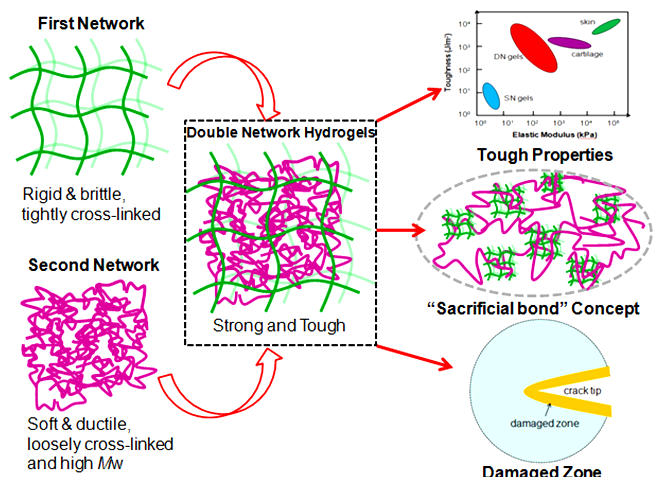
Polymer gel is categorized as soft & wet materials the same as biological soft tissues. However, the poor mechanical properties remain the largest barrier to traditional synthetic hydrogels for extensive practical applications. In order to create a highly strong hydrogels, we invented a facile "one-pot" method to prepare high strength and tough double network hydrogels (DN gels). It is our belief (and hope) that this novel method and the DN hydrogel systems developed in our work will open a new avenue to gel research. We focus on the research of DN gels recently, but we are also intererted in other high strength hydrogels, like nanocomposite hydrogels, hydrophobically associated hydrogels, and so on, in that the combination of DN gels with other high strength hydrogels is a interesting field to achieve high strength and other funtional properties (fatigue resistance and/or self-healing) of DN gels.

2) Structure and Properties of Polymer Nanocomposite
Polymer nanocomposite emerged as one of the most promising developments in the area of flame retardancy, appearing to offer significant advantages over conventional formulations. Much attention was diverted to the use of layered silicates (clay) and carbon nanotube, as a great potential for producing materials characterized by improved flame retardancy along with superior physical properties. We had developed poly (vinyl alcohol)(PVA)/laponite and gelatin/laponite nanocomposites, and it was found that the light transmittance of nanocomposite films was not reduced by adding laponite, and the thermal stability was obviously enhanced as Laponite content increased. Recently, we also developed flexible and transparent clay films using laponite and sodium carboxymethyl cellulose (CMCNa) as materials, and the content of clay was up to 70%. The clay films showed good thermal stability and a nacre-like brick-and-mortar microstructure (unpublished results). Graphite, graphene oxide and carbon nanotube are also attempted to prepare flexible and conductive carbon films. Carbon nanotube was also attempted to disperse in aqueous using the temperature- and pH- core-shell microgels as dispersant. It would be stable more than 10 days. The dispersion also showed temperature- and pH-sensitive.
3) Synthesis and Application of Nanoparticles
Core-shell polymer nanoparticles were prepared by grafting polymerizationwith temperature-sensitive core and amine-rich shell. The tert-butyl hydroperoxide initially interacts with amino groups on the polymer backbone (Polyvinylamine) to form redox pairs that are capable of initiating the graft copolymerization.The amphiphilic graft copolymer generated in situ thus acts like polymeric surfactants, self-assembling to form a micelle-like microdomain, which subsequently promotes the polymerization of the monomer. Well-defined and stable colloidal is produced in the absence of surfactant and stabilizer. The particles entrapped PVA gels were used as a multifunctional platform for release of hydrophobic or hydrophilic drugs.
Inorganic nanoparticles using water-soluble polymers or hydrogels as template: Flake-like Mg(OH)2 nanoparticles were synthesized using gelatin as template.
4) Synthesis and Properties of Water-soluble Polymers
Water-soluble polymers can be synthesized by aqueous radical polymerization or aqueous dispersion polymerization. Novel structure water-soluble polymers, such as hydrophobic modified polyacrylamide and polyampholyte, have been prepared, and the solution properties were also characterized by viscosity experiments. The interaction between polyampholyte and anionic surfactant (SDS) was also investigated. It found viscosity increased more rapidly as salt concentration increased at IEP even though low SDS concentration used.
5) Others
Preparation and characterization hydrophobic starch by NMR: The detailed chemical microstructure of native starch and acetylated starch was confirmed by 1H NMR, 13C NMR and 13C–1H COSY spectra. Analysis of 1H NMR spectra of acetylated starches was assigned accurately. Compared with native starch, the hydrophobic performance of acetylated starch esters was increased.
